

It's Just a Twirl
Seeing mistakes through the eyes of the universe

Dear Kula Diaries,
In 2011, I traveled to the tiny kingdom of Bhutan for a trek through the Himalayas. It was, quite honestly — the dream trip of a lifetime. I had no idea that upon my return home, my entire ‘normal’ life was going to be flipped upside down. On my first day back from that trip, my boss sat us down at a picnic table in the park shop and told me and my fellow park rangers that we were likely going to be laid off. In what felt like the blink of an eye, my dream job as a ranger was ripped out from under me.
At the time, I couldn’t see a silver lining, and had anybody told me to look for one, it would have been met with some unkind words. But as life will teach all of us, the only thing consistent about life is change, the ebb and flow of everything… and here we are to experience it.
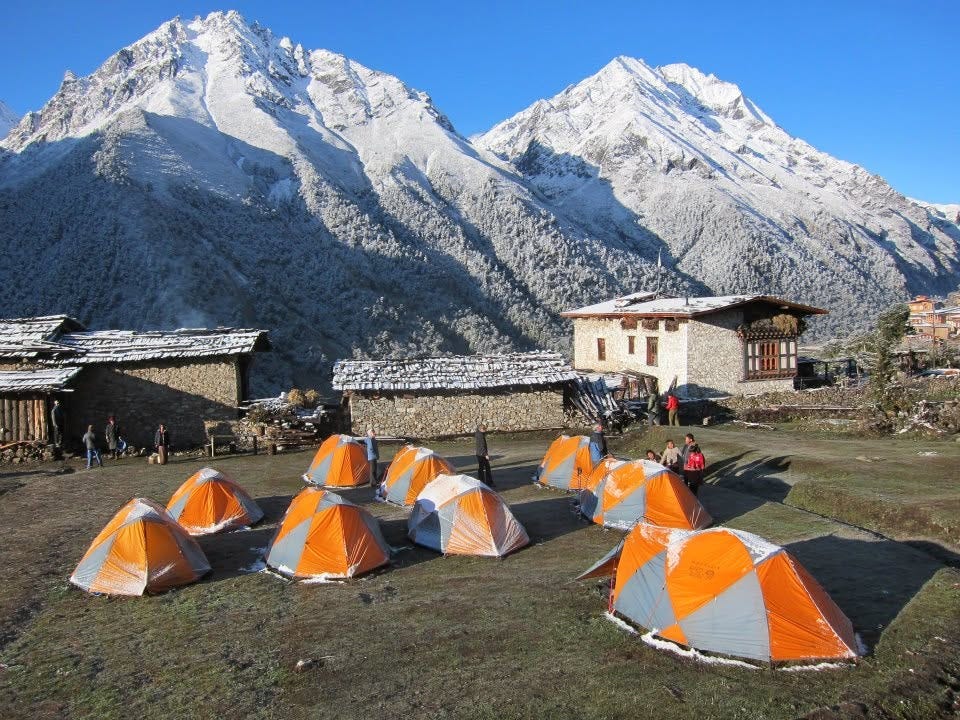
I was thinking about that trip to Bhutan a few days ago and about something that happened there on the last day of the trek. I desperately did not want that trek to end. I was in a place in my life where I was married to a (now ex) husband that I wasn’t spending any time with, and I was using the mountains and hiking to escape from pretty much all the discomfort that I had ever felt in my life. Day to day, I was living out the ultimate grown-up form of running away from it all.
If I wasn’t hiking, I wasn’t happy. And so, as you can imagine, for those 18 days when we were hiking through the Himalayas, I was the happiest that I had ever been in my life. But that’s the thing about running from something: If you don’t keep running, it’ll eventually catch up to you. I wasn’t in a position where I could continue running forever. And in fact, I shouldn’t have. Sometimes you just have to face the storm head-on and figure it out.
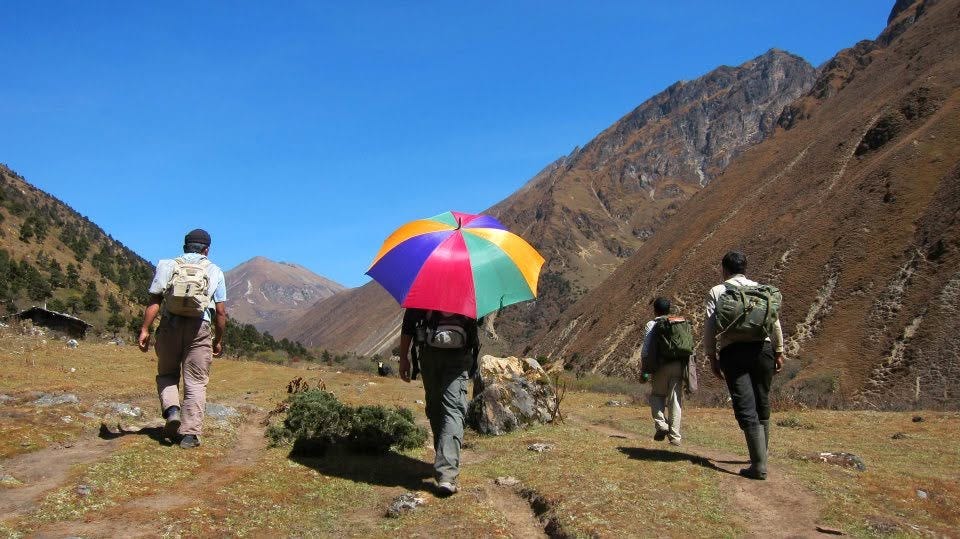
And so it was on that last day of the trek, when I was grasping for the last tiny straws of it, that something happened:
We arrived at the final town on our walk, a remote village called Gasa. In fact, while I was there, they were in the final stages of finishing a road to this village. It was the first time a road had ever met the village. Prior to that, in order to leave the town, you had to walk or ride a horse, which the villagers had done their entire lives. But suddenly it was opening up to more people and more travelers due to an impossibly steep and precarious road being built into the side of a hill that would surely be a slide hazard for the rest of its natural-born life as a road.
And it was on this last day that we arrived at a monastery, as we had many times previously on the trip. At these monasteries, it was customary to remove your shoes and enter one of the prayer rooms where the monks were praying. We would sit down along the wall on pillows specifically set up for visitors so that we could listen and meditate and pray along with the monks. Several times the monks offered us tea or they dusted us with flour, a blessing meant for good luck and living to a ripe old age.
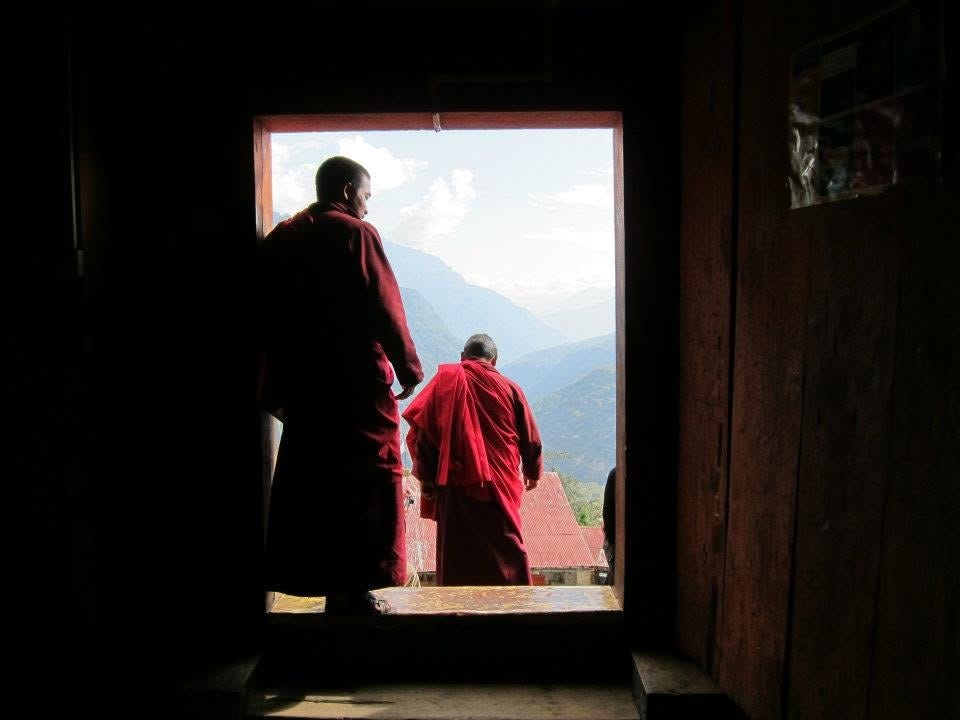
As we walked towards the door, I was with two fellow male trekking companions from our group. We approached the threshold and there was a little bit of a language-barrier commotion with one of the monks trying to say something to us, but us not fully understanding it. Then, there was a flurry of nods and head shaking — humans attempting to understand each other, but not really doing a good job of it. Try as I might, I was not able to learn Dzongkha (the primary language of Bhutan) for this trip. At that time, there was no Google Translate or Duolingo Dzongkha available (I’m pretty sure there still isn’t).
This is the traditional greeting in Bhutan:
ཀུ་ཟུ་ཟང་པོ
The correct pronunciation is, ‘Kuzu zang po’. It’s the Bhutanese version of “Hello” or “How Are you?” — one of the coolest memories that I have from Bhutan is seeing a yak herder far up on a treacherously steep hillside, deep in the Himalayas. He must have spotted our small group, because suddenly, we heard his echoing call, Kuuuuuzzzzuuuuuuu zaaaaaanggggg pooooooo!!’ reverberating through the entire valley. Our group, completely delighted, shouted back joyfully… and for nearly 5 minutes we exchanged echoing calls of greeting, before eventually continuing on our hike.
This time, after exchanging kuzu zang po at the threshold with the monks, and despite the apparent miscommunication, we ducked through the small door and entered the prayer room. Quietly and respectfully, we found our cushions along the wall, and sat down in a cross-legged position. The moment I sat down, I saw every eye of every monk turn to look at me, and all the monks started anxiously twitching on their own prayer mats and snickering amongst themselves while simultaneously looking at the head monk at the front of the room and then back at me.
I smiled and waved and sort of shrugged my shoulders stupidly and wasn’t quite sure what was going on.
As I sat there watching everything unfold, I could tell that something had happened or something was wrong, but I wasn’t sure what I had done. All I knew was that every eye was on me and then back to the head monk, and then on me, and then back to the head monk. I remember having this panicked feeling inside, like, Oh my gosh, did I do something to offend them? Since we had been going into monasteries the whole time, I couldn’t recall that I had done anything different in this one.
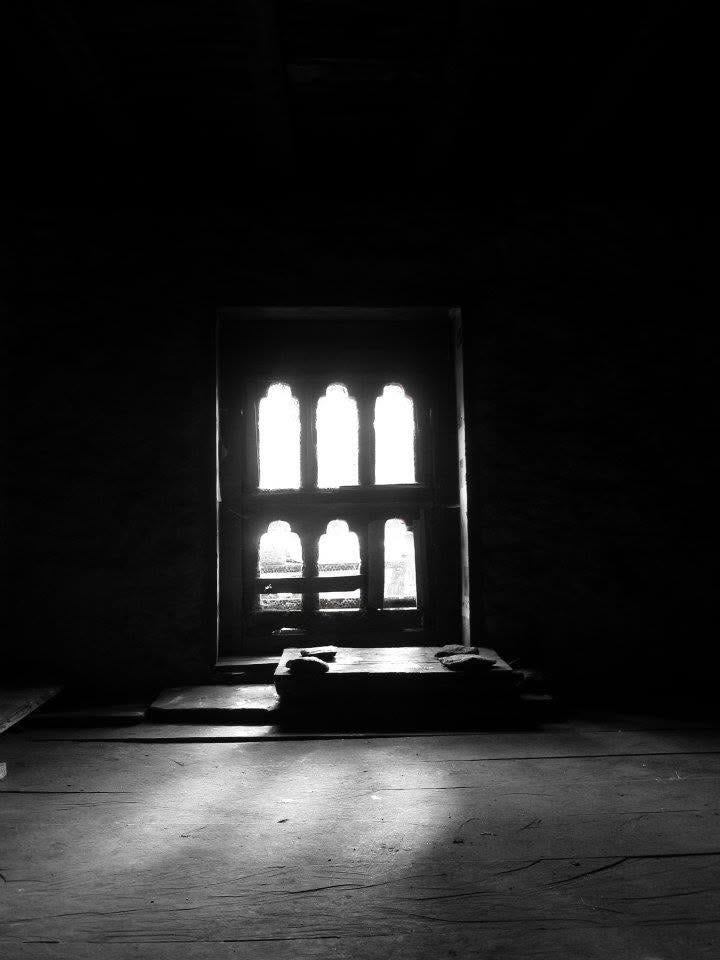
I looked imploringly at the head monk at the front of the room, who was sitting on a slightly elevated cushion, leading the prayers, half expecting him to give me some sort of directive. But that’s not what happened.
Instead, a huge smile broke out on his face, the biggest smile I’ve ever seen, and he threw his head back and started to laugh. That laugh rippled through the room like a wildfire, and soon a room of almost 40 monks was hysterically laughing. And at that point, so was I, and so were the two trekking companions with me.
Together we all sat in that room hysterically laughing, and I had no idea why. I just knew that it was the funniest thing that had ever happened to me in my life.
Even today, just thinking back on that moment, the uninhibited joy is palpable as I write these words. I have never felt anything quite like it, a reverberation of laughter that indeed felt like it was welling up from and enveloping the whole universe.
Eventually, the monks went back to their prayers, their chanting, and their singing, and I sat in the room with my eyes closed, letting their voices wash over me. I remember opening my eyes at one point and looking up, surprised to see that one of the younger monks had slipped a stashed cell phone from under his red robe, and was actively texting. He looked at me and held up a finger, as if to say, Shh, let’s keep this between us.
I smiled back.
Afterwards, as we left the room, several of the monks asked to have their photo taken, which I did, and they huddled around me while I showed them the photographs of themselves. This was long before smartphones, and many of these monks had never seen a photograph of what they looked like.
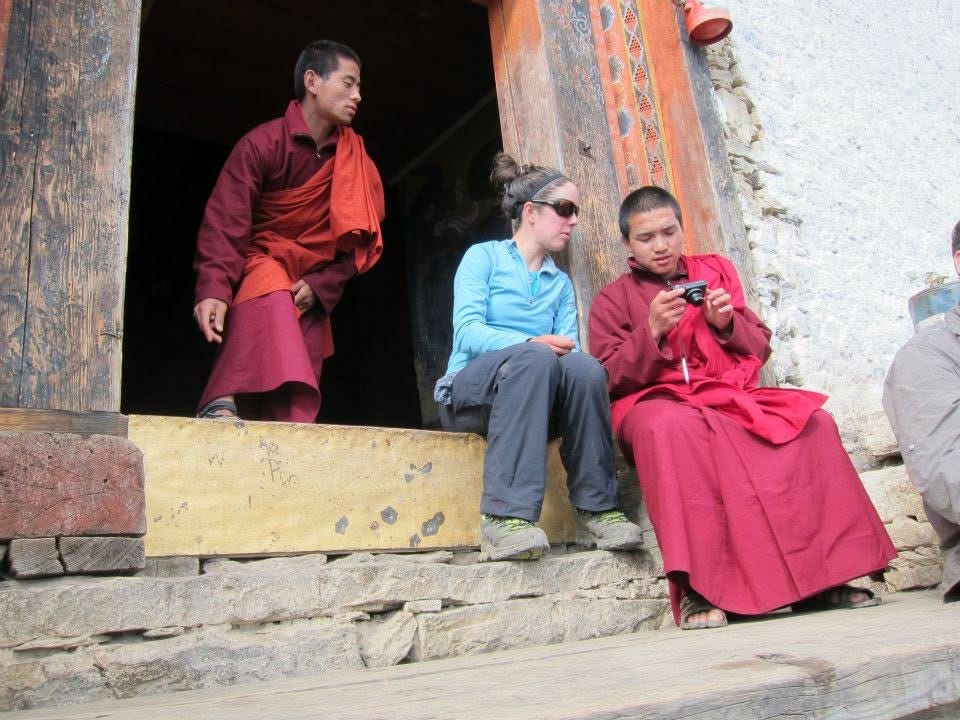
Our guide eventually arrived and started talking with one of the monks at the door, and I could see that the conversation was getting more energetic as they both started to laugh. I walked up to Ugyen (our guide) after he was done talking with the monk and asked, “Did they say anything about what happened in there?” I was so curious about the laughing incident.
Ugyen smiled at me.
“Women actually aren’t allowed in that room,” he said.
I gasped. I was immediately horrified by the disrespect that I had inadvertently showed. The mistranslation had gone horribly wrong, and we had assumed that I was allowed in. Whether or not I understood the traditions and customs of the Buddhist monks was irrelevant. They clearly had a rule, and I very clearly had not followed it.
I put my hand over my mouth. “I am so sorry,” I said.
I felt so embarrassed for my behavior. Here I was, just another stupid tourist.
Ugyen shook his head. “It’s all good,” he said. “It made their day.”
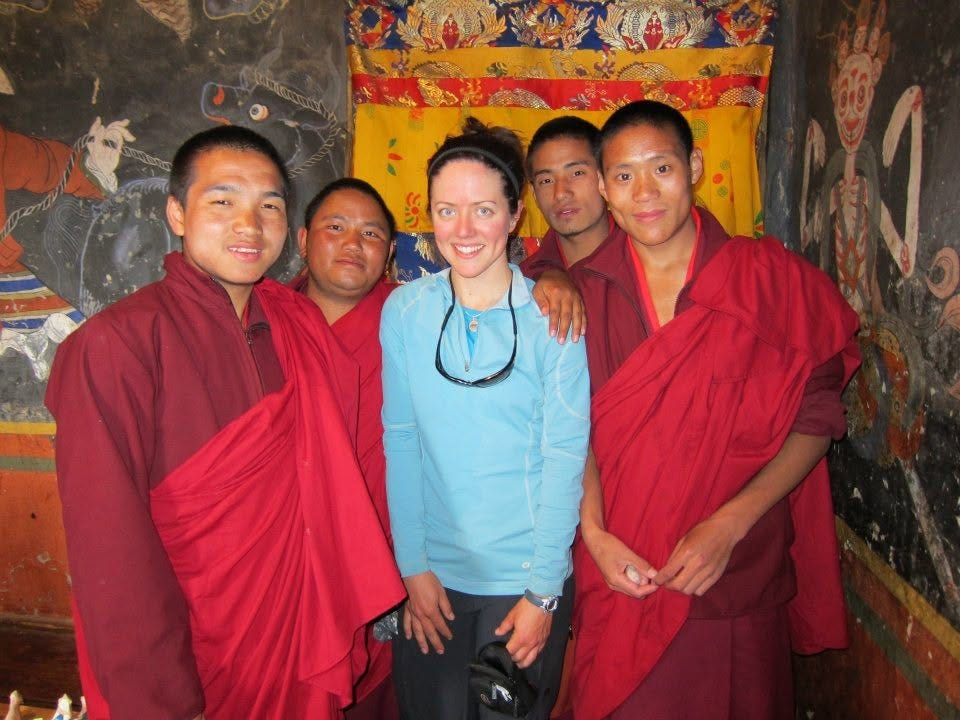
I’ve reflected back often on that moment and on the kindness of those monks. Many people would have rolled their eyes at the dumb American tourist who unknowingly wandered blissfully into a male-only meditation room. But instead, these monks exemplified what it means to practice acceptance and peace and to go with the flow of the universe, even when it’s not what you want.
They were able to see the artificial boundaries set by humans and could see that this was not a misstep in the dance of life, but rather a twirl. They knew that they could choose to see this as a stumble with pain, or as a delicate wisp of the cosmos, with the ability to witness it as a thing of beauty and a source of laughter and joy. The ultimate alchemy: turning the energy of the universe itself into love.
Of course, this doesn’t mean that we shouldn’t have rules or structure, and I don’t think that that’s what the monks were implying or accepting. And it’s certainly not what I’m suggesting. If I went back, I wouldn’t enter that room out of respect. But at that time, I did, and there were two ways to handle it. And the monks chose and made a deliberate decision to see that instance through the lens of the universe itself and not through the lens of human-made structure and rigidity.
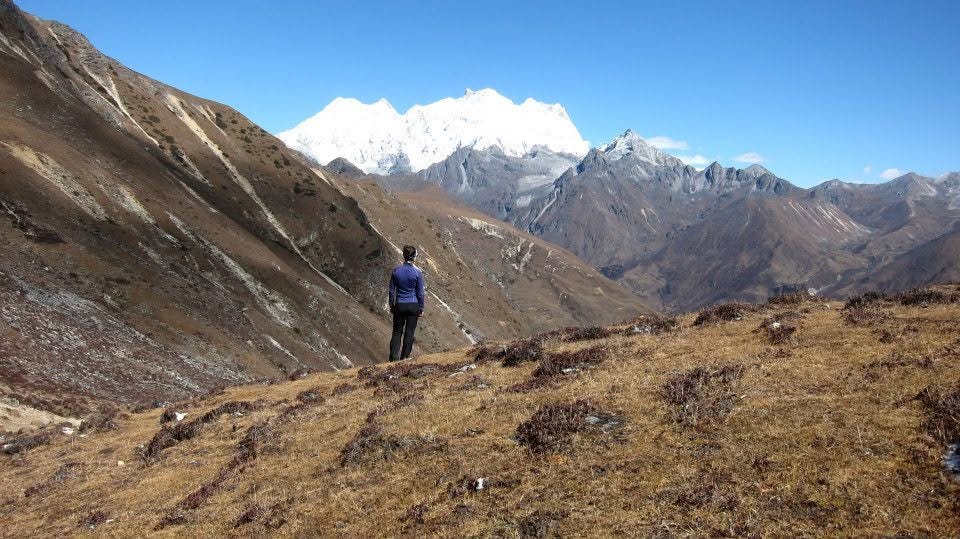
I think of those monks often, particularly in moments where it feels like nothing is going right, or at least not the way that I wanted things to go.
It’s just a twirl, I’ll think.
And sometimes, not always, but sometimes I swear that if I listen closely enough, I can still hear the faint echo of those monks laughing.
Friends — it feels SO special to recall this wonderful trip to Bhutan, which — more than 15 years later, I still think about often. It was and is one of my favorite memories, and I’m so truly grateful for the 18 days that I spent there. I was definitely in a different place in my life during that time — when I came back from Bhutan, I sunk into a very deep depression — but I know that, ultimately, what bloomed from that place of sadness and loss, was something of great beauty and resilience. I no longer ‘need’ to go on wild adventures in order to feel happy — and I love living with the knowledge that these special walks in beautiful places have helped to shape the story of my own life — as I am sure your walks and hikes have done for all of you.
I’ll end today with the traditional Bhutanese/Tibetan farewell (which, like ‘aloha’, can also serve as a greeting for best wishes and good luck)— Tashi delek!

I went from laughing to happy crying, which I think happens often when I read your writing my friend 💜💜💜